
Tag: Studies for the World

  • Online Privacy: The PRIPARE Project

    Online Privacy: The PRIPARE Project

    Last year I sat down with professors Perry and Roda from the American University of Paris and discussed their work on the PRIPARE project on online privacy. This piece was published as part of the “Studies for the World” series on aup.edu.

    A woman enters a liquor store. She slowly peruses the isles. The man behind the counter watches her. Eventually, she walks up to the counter and casually hands him a twenty dollar bill. Within seconds, he has figured out her name, where she lives, her birthday, her height and her birthplace. Merely by glancing at her ID.

    Unwittingly, we do the same every single day. We hand over countless pieces of personal information that are irrelevant to the transactions we undertake, whether we are buying shoes online or signing up for a newsletter.

    There is a dire need for policy to moderate this, Professors Claudia Roda and Susan Perry, of the Computer Science and International and Comparative Politics department respectively, argue.

    Professors Perry and Roda, together with Professor Kung, participate in the PRIPARE project, PReparing Industry to Privacy-by-design by supporting its Application in Research, in order to re-establish privacy as a human right. Eleven institutions have sponsored the project: from academic institutions such as AUP to large companies the likes of Atos. The project is funded by the European Commission, which awards grants to as little as 7% of the project proposals it receives.

    “There is a pressing need for legislation that protects citizens’ privacy,” argue both Professors Roda and Perry, “and an obligation to inform the general public about what that entails.”

    Individuals like Edward Snowden have already raised the alarm on systems of global surveillance and the dangers they pose to individual private data. However, most citizens do not understand the extent of the threat.

    And neither do companies. Perry and Roda suggest that, “Companies do not take the consequences of non-compliance seriously.” They hope this will change once the European Union‘s Data Protection Act comes into force in 2017.

    “Right now,” they continue, “privacy is de-facto regulated by private companies as opposed to democratically elected bodies.” Google and Facebook have control over privacy standards, which is, Perry argues, “like letting restaurants set their own hygiene standards.”

    How does this translate in our everyday lives?

    Well, those private messages you send on Facebook might not be so private. Two years ago, an article on Buzzfeed revealed that Facebook has a team that reads through private messages if they have been flagged by an automated tool.  The tool sifts through content, searching for violations of Facebook’s terms of service, such as “mature content”. If a private message is flagged, employees intervene and read it.

    The online consequences of privacy violations can be extremely serious: damaged reputations, stalking, peer-pressure, bullying, blackmail…

    Perry elaborates, “Article 17 of the Universal Declaration of Human Rights outlines the right to property. Right now property, in the form of data, is being stolen from its owners. Users need to be able to knowingly accept the privacy settings of their data.”

    Perry and Roda go on to explain that there is a fundamental disconnect in privacy practices: users are required to put trust in data controllers, even if trust in these circumstances is not articulated in law.

    One solution would be data minimization through processes like PETs, Privacy Enhancing Technologies, which ensure that only essential data is collected and that it is destroyed as soon as it is no longer needed. This would be the equivalent of our protagonist buying alcohol and only showing proof that she is “of age.”

    keyboard

    Roda explains, “Privacy needs to be more than just an afterthought, it needs to be directly implemented in the design. Unfortunately most engineers are not well versed in ethics.”

    Perry adds, “Most people in the IT industry don’t understand that the consequences of privacy violations may have a negative impact on the environment, on the fight against cyber-crime, on their branding. The GAFA (Google Apple Facebook Amazon) don’t take human rights into account in the design of their platforms and services.”

    The PRIPARE project has been working closely with Atos, a French multinational IT services corporation, to ensure security and privacy go hand in hand in their designs. “Data functions much like money: big data is the currency of the twenty-first century, we just need better banks,” concludes Perry.

    All in all data has become a valuable resource that enables companies to market to users but it also needs to be used sparingly and in compliance with users’ privacy.

    Professors Perry and Roda have worked on various projects together, including an upcoming book on Human Rights and Digital Technology and a Topics course on Human Rights and Digital Technology. The European Union selected the latter as one of its recommended ENISA curricula for 2014. They hope to turn AUP into a privacy by design campus and set an example as to how universities can better combine privacy and technology.
  • Art And The Market

    Art And The Market

    In my time at the American University of Paris, I shadowed and subsequently wrote about a guided visit of famous auction house Christie’s in Paris. The original “Studies for the World” piece can be found on aup.edu.

    Professor Meaghan Scott‘s class for Art and the Market had several unique opportunities this spring, among them a visit to Christie’s, the famous art auction house, led by Simon de Monicault, the director of the furniture department. Communications Coordinator Marie Rousseau joined the class on the visit and shares her experience.

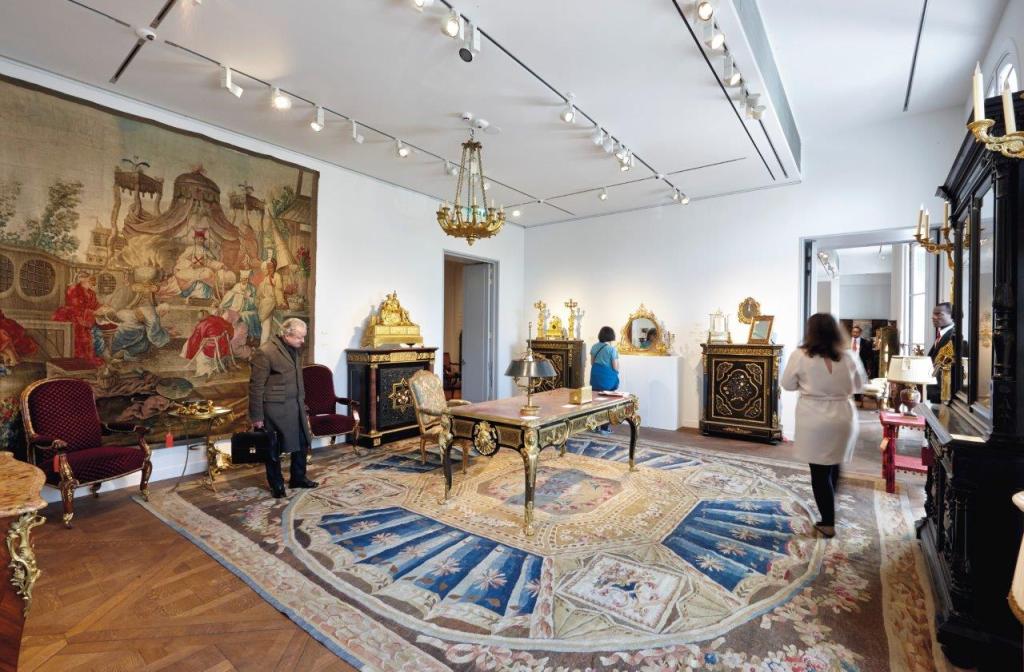
    As we enter into the central room of “Le Goût Français” (The French Taste)  the upcoming sale exhibit on decorative arts from the 13th to the 19th century, our guide informs us that before paintings took over in the early 20th century, decorative arts were the preferred art form.

    “Selling art is an intricate business,” he explains. First, the seller establishes a reserve price, which is a price under which he or she will not sell the art work. At an auction, an auction house like Christie’s will bid on behalf of the seller until the reserve price is reached.

    De Monicault motions over to a pair of candelabras estimated between 200 and 300,000 euros. There is also a question of strategy on part of the auction house. For example, with period furniture and art objects, a choice often has to be made as to whether to keep identical pieces together or not. This decision is made all the more difficult when there are, say, four identical chairs. Should they be sold as an ensemble or in sets of two? Indeed people no longer desire matching furniture and it is imperative to cater to current taste in interior design.       

    Our guide beckons us over into another room and pulls out a rare piece: a mirror and book holder that belonged to Caroline Bonaparte, Napoleon’s younger sister. Provenance is incredibly important in the art market. “Napoleon enthusiasts would definitely find this item of interest,” de Monicault adds.

    Christie’s also has a wealth of contacts and tools it can draw on to promote a sale. For example, for the sale of a cabinet estimated at a million euros, it is possible to organize a VIP dinner with say, Hubert de Givenchy, as an event around the sale. It is also possible to showcase works in its various galleries all around the world: from New York to Shanghai. Christie’s prestige is an essential asset in bringing together all the means to make a sale successful.

    We walk into another room, this time containing a large Louis XIV style wooden desk. De Monicault explains that correctly assessing the origin of a piece is crucial: for example an original of this type of piece is worth 2 to 3 million whereas a copy is worth about 40, 000 euros. When a potential seller contacts Christie’s, its experts first ask for pictures. Then, if the piece seems of interest, they go to see it in person to determine exactly what it is and how much it is worth. “Christie’s job is to be as knowledgeable as possible,” de Monicault underlines. Indeed its work requires dealing with many different pieces with the help of talented experts.

    “When it comes to paintings,” he continues, “things are very structured.” There is often a catalogue raisonné, a comprehensive listing of all the known works of an artist, and institutions like Christie’s need to subcontract the decision about authenticity to a committee. He adds, “It’s impossible to sell a Picasso if you don’t have the necessary Picasso reference!” Old master paintings are the hardest to authenticate; even experts and museum curators change their minds. However jewelry is much easier.

    As we come to one of the last rooms, de Monicault explains that Christie’s likes to expose contemporary paintings along with period furniture to show potential buyers that it is possible to blend periods and styles.

    The internet has vastly changed the art market landscape: 5 to 10 years ago Christie’s communicated with its clients solely through its bi-annual paper catalogue. Nowadays Christie’s produces an e-catalog and even has online-only sales on its website. As a result, on top of bidding in person and over the phone, clients can now bid for millions of euros online. Just this April, Christie’s organized an online-only Andy Warhol sale.

    As our visit draws to a close, a student asks about the difference between the art market in France and the U.S. De Monicault takes a second to think. “French buyers are more discrete,” he remarks, “and France has more stringent laws with regards to art conservation.” For example, before each sale, museum experts come in to estimate pieces and assess whether they are “of national interest.” If they are, the State makes an offer at a fair market price and replaces the final bidder. In the U.S. museums have to bid on works of art by themselves.

    We bid adieu to our graceful guide for the day and file down the large marble staircase and back onto the Parisian streets. We have become art in the market experts in our own right.