Tag: art

  • Warhol’s Shadows

    Warhol’s Shadows

    During my time as Communications Coordinator I interviewed Hervé Vanel, art history professor and co-curator of the Paris Museum of Modern Art fall 2015 Warhol exhibit. The original piece was published on aup.edu.

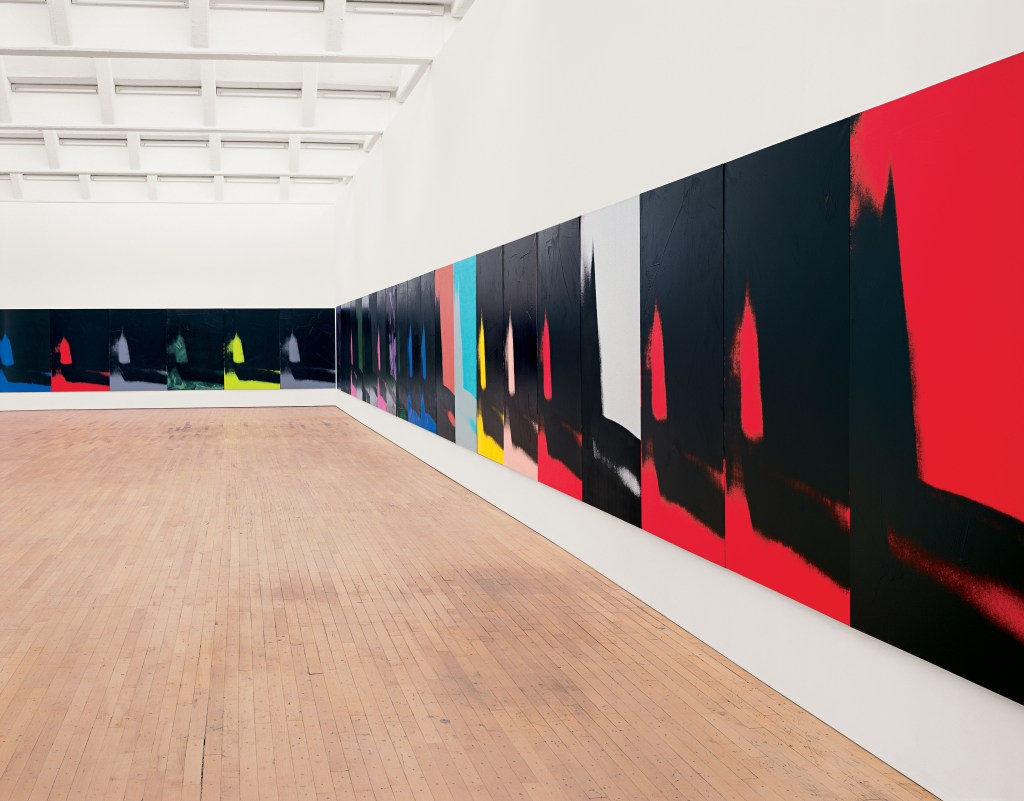
    One of Warhol’s often overlooked works is the Shadows – 102 paintings from 1979 that were commissioned by the DIA foundation. The silkscreened paintings feature two compositions based on a picture of a shadow from Warhol’s studio. They range in color from aqua green to bright yellow to blood red. Warhol was always very specific about how the Shadows were exhibited. He wanted the paintings hung edge to edge forming a long strip running along the walls of the gallery.

    This fall, a landmark exhibit of Warhol’s work featuring the Shadows is opening at the Musée d’Art Moderne (Museum of Modern Art), curated by art history Professor Hervé Vanel. He kindly agreed to discuss the upcoming exhibit with us.

    How did you conceive of the exhibit?

    When the director of the Musée d’ Art Moderne Fabrice Hergott, co-curator Sébastien Gokalp and I started thinking about the project the aim was not to produce a retrospective but an exhibit that would introduce the viewers to the Shadows.

    As a curator, I believe the most important element of an exhibit is the relationship between the work and the viewer. In the case of the Shadows you can attempt to look at one painting after another but in reality your attention drifts. You become distracted and start seeing the piece as a whole, as if it were an installation. Throughout the curating process, we realized the characteristics of the Shadows are present throughout Warhol’s work and decided to introduce viewers to the piece through other works which elicited similar reactions.

    We chose Warhol’s screen-tests as the openers for the exhibit: close-ups of faces in which the subjects are sitting down, merely ‘watched’ by the camera. Most people are trained to relate to artwork as attentive observers but with the screen tests new possibilities arise. You can analyze how each specific subject responds to the camera or you can observe them in a state of distraction.

    What feelings did you wish to elicit in viewers?

    We wanted to elicit the types of feelings that Warhol treasured most: ones that are frowned upon, such as boredom. As a viewer you shouldn’t be bored. An artwork is meant to be interesting and therefore your attitude towards the artwork should be respectful and contemplative but with Warhol this approach is disrupted.

    What other aspects of Warhol’s work did you wish to highlight?

    We wanted to highlight the density of Warhol’s work to retrieve its original impact when it was exhibited in the 60s and 70s. We were specifically thinking of the 32 Campbell soups, the flowers, the electric chairs… With a retrospective, it’s a matter of selecting the best works. However it quickly becomes apparent that this does not function with Warhol’s work: would the best Campbell Soup painting be chicken noodle or mushroom? What matters is the sheer number of paintings which leads to a saturation and a feeling of blurred boundary between the canvas and the space. This is why the Shadows are extremely central and important to the conception of the exhibit.

    Warhol himself actively encouraged this vision. In the summer of ’62, Warhol exhibited 32 Campbell Soup cans as one of his first major exhibitions in Los Angeles. Irving Blum, the art dealer, started to sell some of them. By the time he had sold three or four, he thought, “Well maybe it’s better to keep them together.” So he called up Warhol and asked for his advice. Warhol agreed. Blum subsequently bought them back and kept the ensemble together.

    Any final insights?

    All in all, we wanted to explore one fundamental question: what are the Shadows telling us about the nature of Warhol’s work? The conclusion we came to is that a sense of density pervades his entire career and offers new artistic horizons for viewers.
  • Rieko Whitfield ’14: A Promising Young Artist

    Rieko Whitfield ’14: A Promising Young Artist

    During my time as Communications Coordinator at the American University of Paris I interviewed and wrote a piece about alumna Rieko Whitfield and her work as an artist. I even got a student to pose with me in one of her exhibits to get a good picture! Spot me! The original piece was published on aup.edu. 

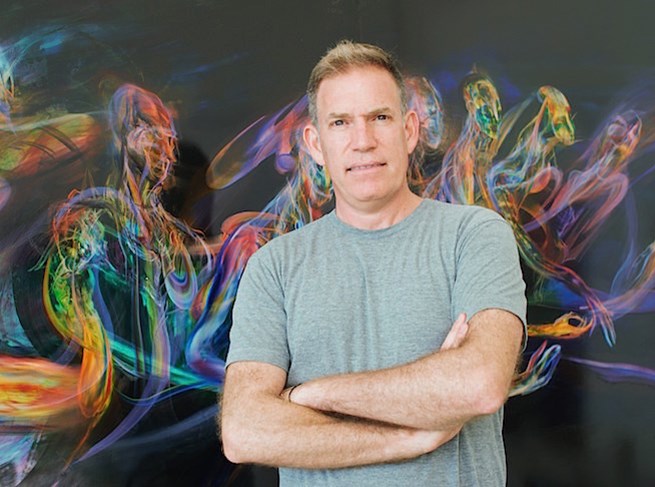
    Rieko Whitfield ’14 is a Japanese-American artist and recent graduate who has worked on various projects both as a student and since graduation. Rieko sat down with us to discuss her work and inspiration as an artist.

    What do have your various exhibits involved? How would you describe your process, and the concept behind your pieces?

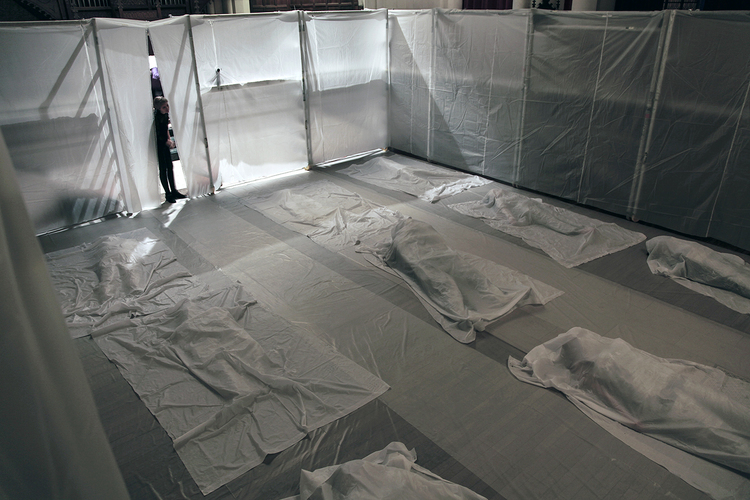
    My installation METANOIA was a curated social performance, transforming a private space into an ephemeral public experience. It consisted of a temporary art installation in the sanctuary of the American Church in Paris  — a 10m by 10m cube constructed out of scaffolds and plastic screens. Inside the installation was a performance consisting of 9 live models encased in sculptures made of wax soaked bed sheets. Each model entered and exited the sculptures at timed intervals. The viewers walked through the cube while filmed by CCTV cameras.

    The live feed was projected on another plastic screen in the adjacent room, creating a voyeuristic experience. The Greek word “metanoia” literally means “change of mind” or “beyond perception.” In the contemporary context the word has come to signify “repentance.” The original meaning of the word does not center around repentance, but rather the shift of perception that precedes it.

    My project Tokyo Dreaming was a site-specific installation in the AUP Fine Arts Gallery. I created a meditative space evoking the mistranslation of memories over geographical and temporal distances. I constructed a canopy using thousands of my late father’s Japanese postage stamps he collected when he was growing up in Tokyo in the 1960’s.

    The display of postage stamps created a portrait of a man I never had the chance to know through the tactile ritual of collecting. Surrounding the installation were dozens of picture frames, covered in mirror film with no images on display. Under the canopy I created a communal lawn space of fake grass and pillows, inviting viewers inside the installation. Tokyo to me is not just a city, but a location in the landscape of my identity.

    My latest project, Kippiebou, is a short film exploring how flesh, being flesh, and interacting with flesh, creates meaning. The three tableaus inflict visceral reflexes of hunger, to desire, to disgust in the course of three minutes (Kippiebou will be featured in WHITEBOX Souvenirs from Earth’s International Video Art Festival).

    My upcoming exhibit is WHITEBOX Souvenirs from Earth Video Art Festival, a public broadcasting of short video works by artists from every corner of the world, curated by AUP professor Barbara Matas and I for contemporary art television channel Souvenirs from Earth. The cocktail reception will take place on May 13th from 7-9 pm at Tokyo Eat at the Palais de Tokyo. The program will be broadcasted daily for 10 days on the cable channel in France and Austria, at Souvenirs from Earth’s permanent installation at the Palais de Tokyo, and online at souvenirsfromearth.tv.

    Where do you source your inspiration?

    My art is an intuitive regurgitation of my dreams, experiences, and obsessions.

    How has your time at AUP shaped you as an artist? Did specific courses or faculty members help you grow?

    At AUP I was given the flexibility to design my own major, in Visual Practice and Critical Theory, so I was able to shape my education to reflect my multidisciplinary practice. I also took several directed studies and was able to spend a lot of time outside of class with professors specifically on my creative projects.

    As I explained to Medium, Philosophy Professor Jérôme Game was intrumental in the development of METANOIA:

    “I began meeting weekly with philosophy Professor Jérôme Game, who served as an invaluable mentor throughout the process of making METANOIA a reality. He told me that as useful as it was to learn by the textbook, it is more important as an artist to think through practice. Professor Game, in essence, called me out and made me realize I needed to think from the bottom up. I tried my hardest to let go of the concepts and names and dates I had memorized for his courses for a moment, and strip my ideas down to its bare bones. I started asking myself more humble, grittier questions. What I came up with were the simplest of “elevator pitches.”


        Peacock TV reports on METANOIA with an interview featuring Professor Game

    Fine Arts Professor Jonathan Shimony’s advice also proved invaluable in finding a space:

    “As I started working on my project, all I knew is that I first needed to find a space to exhibit my work. I spent several afternoons brainstorming with Fine Arts Professor Jonathan Shimony about different options for spaces around Paris. I brought several rough sketches to explain equally rough ideas about what I wanted to exhibit. As I rattled off my fragmented ideas, Professor Shimony suggested lists of galleries and spaces in Paris that could potentially house my large-scale creations.”

    Lastly, what advice would you give to freshmen who are considering majoring in Fine Arts?

    There is only so much you can learn from the textbooks. You have to take risks, make mistakes, and get your hands dirty. Go out to gallery openings and reach out to the people who inspire you. Cherish the fact that you are young, and studying in one of the greatest cultural capitals in the world!

  • Combining Art And Finance

    Combining Art And Finance

    I interviewed art fund co-founder and former banker Serge Tiroche and wrote his profile as part of series showcasing successful alumni from the American University of Paris. It was also adapted for a fundraising brochure. The original article can be found on AUP’s website.

    Serge Tiroche ’92 was born in Israel in 1966 into a family of art dealers: his father was a gallery owner in NY, Tel-Aviv and Paris. He grew up in Jaffa and, after his military service, moved to Paris to complete a BA in International Business Administration with a minor in Modern Arts at AUP. Tiroche’s studies marked the beginning of his adventure blending his knowledge of finance with his passion for art. Tiroche made his debut in the art world in 1986 when he interned at Parisian auction house Loudmer.

    After graduating in 1992, Tiroche co-founded the Tiroche Auction House in Israel and became more involved with his family’s international art trading activity. Tiroche subsequently worked in banking for a decade before pursuing his passion and founding Art Vantage with his partner, Russ DeLeon. Art Vantage holds the artworks of the Tiroche DeLeon Collection, a collection made up entirely of works by artists from developing countries from Serbia to Singapore.

    Tiroche notes, “My relationship with art started when I was very young but I mostly considered it a hobby until quite recently. I became obsessed with collecting contemporary art so I decided to make it my full-time job, combining my investment know-how and my passion for art.”

    The Fire of 1841, Liu xiaodong
    The Fire of 1841 by Chinese artist Liu Xiaodong

    Through the collection, Tiroche wishes to level the playing field for non-Western artists on the art market as well as provide an attractive investment prospect. The collection also lends its works to independent curators, museum directors and galleries as a part of its global lending program.

    I became obsessed with collecting contemporary art so I decided to make it my full-time job, combining my investment know-how and my passion for art.

    Tiroche explains, “There has been a seismic shift in the art market: ten years ago, less than 2-3% of the art sold went to collectors in emerging markets. Today that number is more 20% to 25% depending on the auction, and it’s growing! Part of the growth we’re seeing in markets and volumes is thanks to the entrance of collectors from new markets.”

    In order to further champion young artists, Tiroche just launched a residency program in his home town of Jaffa. Singaporean artist Ruben Pang completed the first residency this July.

    Tiroche believes the connection established with artists in person is invaluable to the process of collecting art, “I think sadly there aren’t many collectors that go to the lengths that I do. Most rely on their point of contact, usually the gallerist who represents the artist. They rarely visit the artist in his studio.” Tiroche himself travels extensively to meet artists and view their work around the globe.

    In terms of trends in emerging markets, Tiroche’s money is on Africa: “I’m a big believer in African contemporary art. I think African art has always been a huge influence on Western art and has traditionally been underappreciated. If you look back at the last ten years, China was the first market that Western collectors explored, then India, Latin America and now Southeast Asia. Africa is a logical next step.”

    Earth Developing More Roots, El Anatsui
    Earth Developing More Roots by Ghanaian artist El Anatsui

    He continues, “In 2013, Angola was awarded the Venice Biennale’s Golden Lion for the best pavilion, a first for an African country, and just this May one of the artists who received the Golden Lion Award was Ghanaian El Anatsui. There’s also a new art fair focused on African contemporary art that started in London three years ago called 154 which is having its first edition in New York this year. All in all there’s more and more evidence that people are looking to Africa and I believe that’s a sustainable trend. Personally, we’ve been growing our African collection consistently over the last two years.”

    Tiroche remembers AUP fondly, “My time in Paris was truly critical in shaping my future, both personally and professionally. The ability to construct my own minor at AUP gave me a broad theoretical basis in Art History, History of Photography, Architecture, French Cinema and even a hands on course in Photography. I also made lots of friends, some of whom I am still in contact with. Plus the croissants and Haussmaniann avenues … I loved every minute.”

    *All photos courtesy of Serge Tiroche.

  • Art And The Market

    Art And The Market

    In my time at the American University of Paris, I shadowed and subsequently wrote about a guided visit of famous auction house Christie’s in Paris. The original “Studies for the World” piece can be found on aup.edu.

    Professor Meaghan Scott‘s class for Art and the Market had several unique opportunities this spring, among them a visit to Christie’s, the famous art auction house, led by Simon de Monicault, the director of the furniture department. Communications Coordinator Marie Rousseau joined the class on the visit and shares her experience.

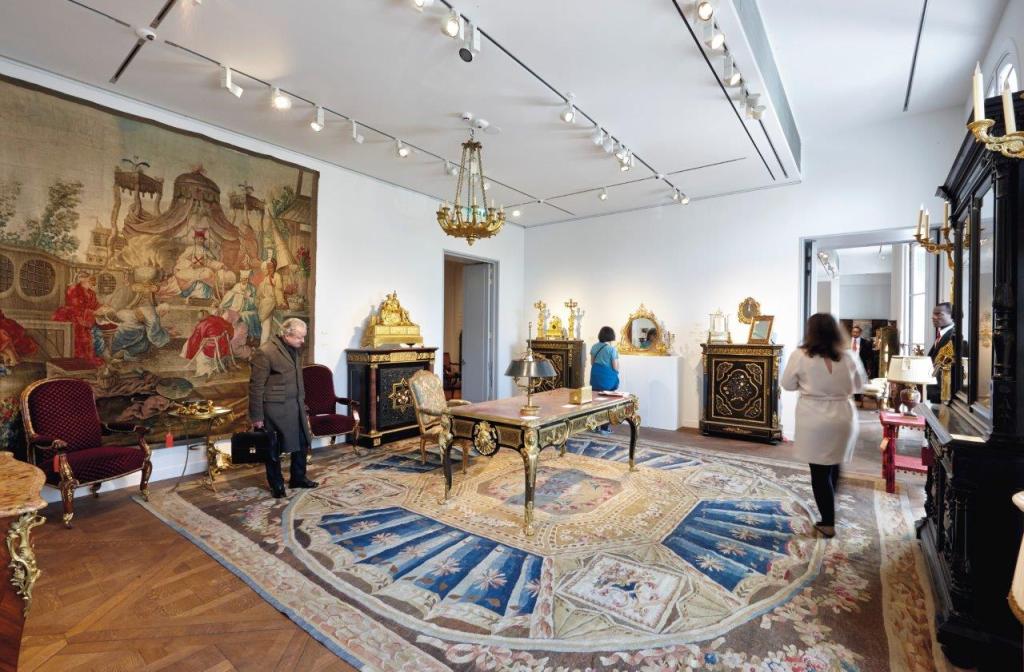
    As we enter into the central room of “Le Goût Français” (The French Taste)  the upcoming sale exhibit on decorative arts from the 13th to the 19th century, our guide informs us that before paintings took over in the early 20th century, decorative arts were the preferred art form.

    “Selling art is an intricate business,” he explains. First, the seller establishes a reserve price, which is a price under which he or she will not sell the art work. At an auction, an auction house like Christie’s will bid on behalf of the seller until the reserve price is reached.

    De Monicault motions over to a pair of candelabras estimated between 200 and 300,000 euros. There is also a question of strategy on part of the auction house. For example, with period furniture and art objects, a choice often has to be made as to whether to keep identical pieces together or not. This decision is made all the more difficult when there are, say, four identical chairs. Should they be sold as an ensemble or in sets of two? Indeed people no longer desire matching furniture and it is imperative to cater to current taste in interior design.       

    Our guide beckons us over into another room and pulls out a rare piece: a mirror and book holder that belonged to Caroline Bonaparte, Napoleon’s younger sister. Provenance is incredibly important in the art market. “Napoleon enthusiasts would definitely find this item of interest,” de Monicault adds.

    Christie’s also has a wealth of contacts and tools it can draw on to promote a sale. For example, for the sale of a cabinet estimated at a million euros, it is possible to organize a VIP dinner with say, Hubert de Givenchy, as an event around the sale. It is also possible to showcase works in its various galleries all around the world: from New York to Shanghai. Christie’s prestige is an essential asset in bringing together all the means to make a sale successful.

    We walk into another room, this time containing a large Louis XIV style wooden desk. De Monicault explains that correctly assessing the origin of a piece is crucial: for example an original of this type of piece is worth 2 to 3 million whereas a copy is worth about 40, 000 euros. When a potential seller contacts Christie’s, its experts first ask for pictures. Then, if the piece seems of interest, they go to see it in person to determine exactly what it is and how much it is worth. “Christie’s job is to be as knowledgeable as possible,” de Monicault underlines. Indeed its work requires dealing with many different pieces with the help of talented experts.

    “When it comes to paintings,” he continues, “things are very structured.” There is often a catalogue raisonné, a comprehensive listing of all the known works of an artist, and institutions like Christie’s need to subcontract the decision about authenticity to a committee. He adds, “It’s impossible to sell a Picasso if you don’t have the necessary Picasso reference!” Old master paintings are the hardest to authenticate; even experts and museum curators change their minds. However jewelry is much easier.

    As we come to one of the last rooms, de Monicault explains that Christie’s likes to expose contemporary paintings along with period furniture to show potential buyers that it is possible to blend periods and styles.

    The internet has vastly changed the art market landscape: 5 to 10 years ago Christie’s communicated with its clients solely through its bi-annual paper catalogue. Nowadays Christie’s produces an e-catalog and even has online-only sales on its website. As a result, on top of bidding in person and over the phone, clients can now bid for millions of euros online. Just this April, Christie’s organized an online-only Andy Warhol sale.

    As our visit draws to a close, a student asks about the difference between the art market in France and the U.S. De Monicault takes a second to think. “French buyers are more discrete,” he remarks, “and France has more stringent laws with regards to art conservation.” For example, before each sale, museum experts come in to estimate pieces and assess whether they are “of national interest.” If they are, the State makes an offer at a fair market price and replaces the final bidder. In the U.S. museums have to bid on works of art by themselves.

    We bid adieu to our graceful guide for the day and file down the large marble staircase and back onto the Parisian streets. We have become art in the market experts in our own right.